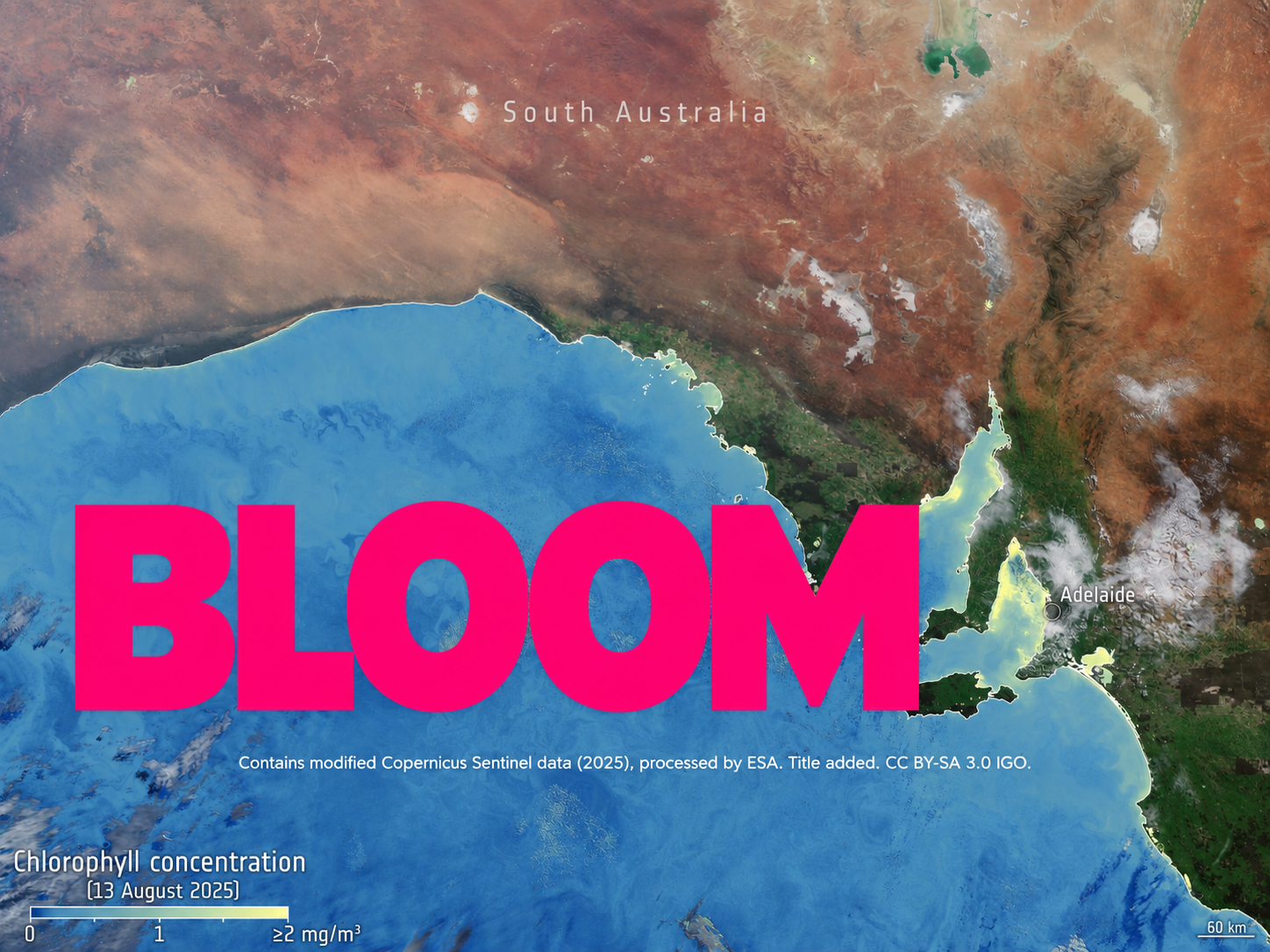
Bloom
Bloom investigates the distance between how environmental change is measured and how it is lived on the Southern Yorke Peninsula. Scientific reports describe the harmful algal bloom through cell counts, satellite maps, and forecasts. People who know this coast also encounter it through changes in familiar places, memories of marine life, and uncertainty about what remains and what might return.
During my residency at Ballara, I will work with community photographs and accounts, published scientific records, and my own coastal and underwater images. Maps, graphs, and numerical tables will be layered over photographs, competing for space and interrupting what can be seen. Seawater will also participate in making the images through a leaking underwater camera and experiments with seawater-treated film.
Bloom asks how a community remembers a changing sea, how ecological grief enters the public record, and what recovery might mean when the water appears clear.
Contribute to Bloom — share your photographs, stories, artworks, and observations.
Artist statement
As a visual artist and environmental scientist, I am interested in how environmental knowledge moves between scientific institutions and the people who live with the changes being measured. Government reports, satellite maps, cell counts, and forecasts document the harmful algal bloom through specialised forms of evidence. Understanding how those measurements relate to a familiar coastline, its wildlife, and its future requires further interpretation. Who undertakes that translation, and how does information become something we can understand emotionally?
I approach these questions through photographs, community contributions, and the published scientific record. I layer maps, graphs, and numerical tables over coastal photographs, underwater images, and family and community archives. Their overlapping surfaces make it difficult to take in everything at once. Data occupies the photograph, obscuring parts of a place or a memory while offering another account of what is happening there. The effort of reading these layers becomes part of the work.
Hot magenta runs through the project, drawing on my associations with seadragons, flowering, reproduction, and care, and recalling the artificial colours of scientific visualisation. The word bloom promises growth within the name of an event associated with extensive loss. Pink holds that tension across images of marine life, family histories, and scientific documents.
Seawater also participates in making the photographs. Through a leaking underwater film camera and experiments with seawater-treated film, it alters the photographic emulsion, leaving material traces of contact. These marks enter the work with the observations, memories, and records gathered during the residency.
Through these encounters, I want to consider how we recognise environmental change, whose experiences become part of its history, and how care continues while people are still working out what recovery might mean.
Research objectives
Examine how environmental knowledge becomes legible. Work with scientific records and community contributions to investigate how measurements are interpreted and connected with everyday experience.
Develop a material photographic language. Test magenta transparencies, photocopies, layered scans, and seawater-altered film as ways of working with evidence, memory, and ecological grief.
Gather local accounts and contributions. Invite people connected with the Southern Yorke Peninsula to share photographs, artworks, poems, stories, and observations.
Develop an exhibition through the research. Create photographic assemblages and arrangements of source material whose form develops through fieldwork, conversations, and studio experiments.
How the project will develop
Working with the scientific record
I will gather published reports, monitoring results, satellite imagery, survey tables, and scientific figures relevant to the Southern Yorke Peninsula. Material will be selected for its scientific significance and for the demands it places on someone trying to understand what is happening.
Each source will be recorded with its title, publication date, location, figure or page reference, and conditions of reuse. Measurements, forecasts, and observations will remain identifiable in the accompanying research, with findings connected to their relevant dates and locations.
Sources will include South Australia’s testing and monitoring information and PIRSA and SARDI’s published algal bloom updates.
Community photographs and accounts
I will meet contributors at Ballara Art & Lifestyle Retreat in Warooka and through individual conversations. Contributions may include recent photographs, family albums, artworks, poems, stories, and observations connected with the coast.
With permission, material will be scanned, photographed, or recorded with the context people wish to share. Dates, places, memories, authorship, and preferred credits will help preserve the relationship between each contribution and the person who entrusted it to the project.
Contributors will be told how material may be layered, recoloured, reproduced, and incorporated into artworks. Permissions will be recorded before material is used, and proposed public uses will be discussed with contributors.
Photographic fieldwork
I will photograph coastal places, people, and marine environments connected with the project. Locations will develop through conversations, access, and the relevance of available records.
Field notes will record conditions and personal observations. Photographs can attend to continued life, uncertainty, and changes that may be difficult to recognise in a single visit.
Layering and reproduction
Scientific graphics and numerical tables will be printed onto transparent or translucent materials and placed over copies of contributed photographs and my own images. These arrangements will then be scanned or rephotographed.
Experiments with magenta, photocopies, tracing paper, scale, density, and alignment will examine what becomes visible or obscured. Moving between a photograph and its accompanying data may change how both are read.
Seawater and analogue film
I will continue photographing with a reclaimed Nikonos II whose worn seals allow seawater to reach the film. Related experiments will involve seawater-treated film, with the conditions of each trial recorded.
The resulting marks will be considered as traces of seawater’s interaction with photographic material. Their relationship with the scientific documents and community contributions will develop through editing, sequencing, and presentation.
Caring for the collection
My responsibility is to listen, document, make artistic decisions, and care for the material entrusted to the project. Contributors determine what they wish to share and how their experiences are described.
Photographs and other contributions will remain connected with their source information, agreed credits, and permissions. Scientific records will retain their context as they enter the artistic process.
The collection will develop through the people who choose to participate. Conversations about its future care and possible uses will form part of the research.
Towards an exhibition
I will work towards a local exhibition shaped by the photographs, accounts, scientific records, and material experiments gathered during the residency.
Possible forms include photographic assemblages, layered transparencies, photocopies, and sequences of images and text. The arrangement will develop through the research and through conversations with contributors about the material they are comfortable sharing publicly.
Bloom is being developed during the Ballara 10th Anniversary Artist Residency at Ballara Art & Lifestyle Retreat, Warooka, South Australia.
Share your photographs and stories through the Contribute to Bloom page.
Contribute to Bloom
Share your photographs, stories, artworks, and observations of the Southern Yorke Peninsula.
What can you see in a photograph because you know this place?
I’m Raquel Trejo, an Adelaide-based visual artist, filmmaker, and environmental scientist. During my residency at Ballara, I am developing Bloom, an art and research project about how people experience, understand, and remember the harmful algal bloom on the Southern Yorke Peninsula.
I am inviting people with a connection to this coast to contribute photographs and the stories attached to them. You can also share artworks, poems, memories, and observations.
A photograph might show a familiar jetty, a family day at the beach, marine life you remember seeing, or a change you noticed in the water. Material from before the bloom can help describe what a place means to people and how that relationship has changed.
What you can contribute
Phone photographs, family albums, work by local photographers, and photographs of everyday coastal life are welcome. You might also contribute an artwork, poem, written account, or observation connected with the bloom.
You can share the context that matters to you. Where and when was the photograph taken? What was happening? What do you recognise because you know this place? What has changed, and what continues?
Approximate dates and partial memories are welcome. Tell me what you know, and indicate anything you are uncertain about.
How contributions may become part of the work
Bloom uses layering, colour, and photographic experiments to examine the relationship between environmental records and lived experience.
With your permission, contributed material may be layered with scientific maps, graphs, or numerical tables. It may also be recoloured, cropped, photocopied, scanned, or incorporated into a new photographic artwork.
Contributions may be considered for a local exhibition, a publication or photobook, or sharing through the project website and social media. The form allows you to indicate which uses you are comfortable with. I will confirm proposed public uses with you before exhibiting or publishing your material.
Credits and permissions
Your contribution will be recorded with the photographer or maker’s name, the information you provide, your preferred credit, and the permissions you agree to.
Please contribute your own work or material you have permission to share. For family or historical photographs, tell me who made the image if you know. If the photographer is unknown, include what you know about its history so permissions can be considered before public use.
You can choose to be credited by name or remain anonymous. Your email address and phone number will be kept private and used to discuss your contribution and permissions.
How to contribute online
1. Upload your files
Open SwissTransfer and add the photographs or other files you would like to contribute.
Choose the option to generate a transfer link and select the longest available download period. Follow any email-verification instructions, and keep the upload page open until the transfer is complete.
Copy the download link.
2. Complete the contribution form below
Paste your SwissTransfer link into the form and enter the exact filename of the item you are describing.
Add the information you wish to share about its maker, date, location, story, and preferred credit. You will also be asked about permissions.
Please complete one form entry for each photograph or item. If you uploaded several files together, you can use the same SwissTransfer link for each entry, identifying the relevant filename.
3. Submit your contribution
Select Submit at the end of the form to send your information and permissions.
You can contact me later to add information, correct a detail, or discuss how your contribution may be used.
Printed photographs, albums, and larger collections
I will be at Ballara from 20 to 25 November 2026. If you have printed photographs, albums, artworks, or a larger collection, please email me to arrange a conversation and discuss scanning or photographing the material.
You are also welcome to contact me to share a story or observation directly.
Raquel Trejo
hola@raqueltrejo.com.au
Developed during the Ballara 10th Anniversary Artist Residency at Ballara Art & Lifestyle Retreat, Warooka, South Australia.